Wenxin, in contextPublic background
AI education founder turning study materials into short-form learning drama
Short-form study dramaAI video educationGen Z study behavior
Only information this Person published appears here.
Wenxin's product direction is simple and visual: take ordinary study material and present it as a vertical, character-led lesson that feels closer to short-form entertainment than to a worksheet or a conventional class.
The product turns the format students already scroll into a study surface: short, vertical, story-led lessons instead of static worksheets.
Wenxin says students found her through TikTok comments and UChicago posts, then asked for specific topics and signed up for the website.
The consumer loop can start with public short videos, while B2B2C can enter through teachers, tutoring centers, and classroom attention use cases.
The constraint she names is AI video generation cost and controllability, which makes infrastructure partners unusually relevant.
Upload study material and generate short drama-style learning videos that feel more like scrolling than homework.
AI video generation makes personalized study content possible, while students are already trained to pay attention to short vertical content.
In the interview, Wenxin says she has 20+ early users on the website, about 600 TikTok followers, and students requesting study topics from her videos.
She is testing a B2B2C path with teachers, tutoring centers, and schools that need to win student attention before a class starts.
Before AI education, she studied materials science in China and says she co-first-authored a JACS Au paper on metal-organic frameworks and pesticide sensing.
A concrete consumer-learning wedge: students already consume short videos, and Wenxin is trying to convert that attention into study behavior.
She frames B2B2C as a path: help teachers regain student attention with lesson-opening videos and personalized materials.
The bottleneck she names is generation cost and controllability, currently discussed around AI video priced by the second.
The interview includes early organic pull from TikTok comments, student signups, topic requests, and a possible public-content-to-product loop.
Who should meet Wenxin
Ready-to-send openings for connectors or agents.
“Wenxin is building a product that turns study materials into short drama-style videos, so students can learn through the format they already like to scroll.”
“Her first user wedge is students who struggle to start studying; she wants to make the transition from entertainment to study much smaller.”
“She is exploring B2B2C with schools and tutoring centers, where AI videos could help teachers win attention at the start of a class.”
“Her current bottleneck is not whether short-form lessons are compelling, but whether AI video can get cheap and controllable enough to personalize at scale.”
Self-reported statements, not verified by HiRey.
Self-reported
Worth verifying
Wenxin introduces herself, her UChicago background, and the startup idea connecting AI and education.
She explains the shift from serious study material to drama hooks, storytelling, and bingeable learning loops.
The conversation covers TikTok posts, early users, the website flow, generated study videos, and Duolingo-style app ideas.
She discusses AI video generation cost, free daily videos, paid personalized creation, and B2B2C with tutoring centers.
Wenxin talks about materials science, lab work, patents, and a JACS Au paper before connecting that background to learning.
Looking to meet
Where the public information on this Page comes from.
A few things worth connecting over. Tap a highlight for its source.
Public Page · topics
Short-form study drama · AI video education · Gen Z study behavior · ADHD and procrastination · Tutoring-center GTM · Personalized study media
Public Page · story
The product turns the format students already scroll into a study surface: short, vertical, story-led lessons instead of static worksheets.
Public Page · perspective
The product turns the format students already scroll into a study surface: short, vertical, story-led lessons instead of static worksheets.
HiRey Moments · public meetings
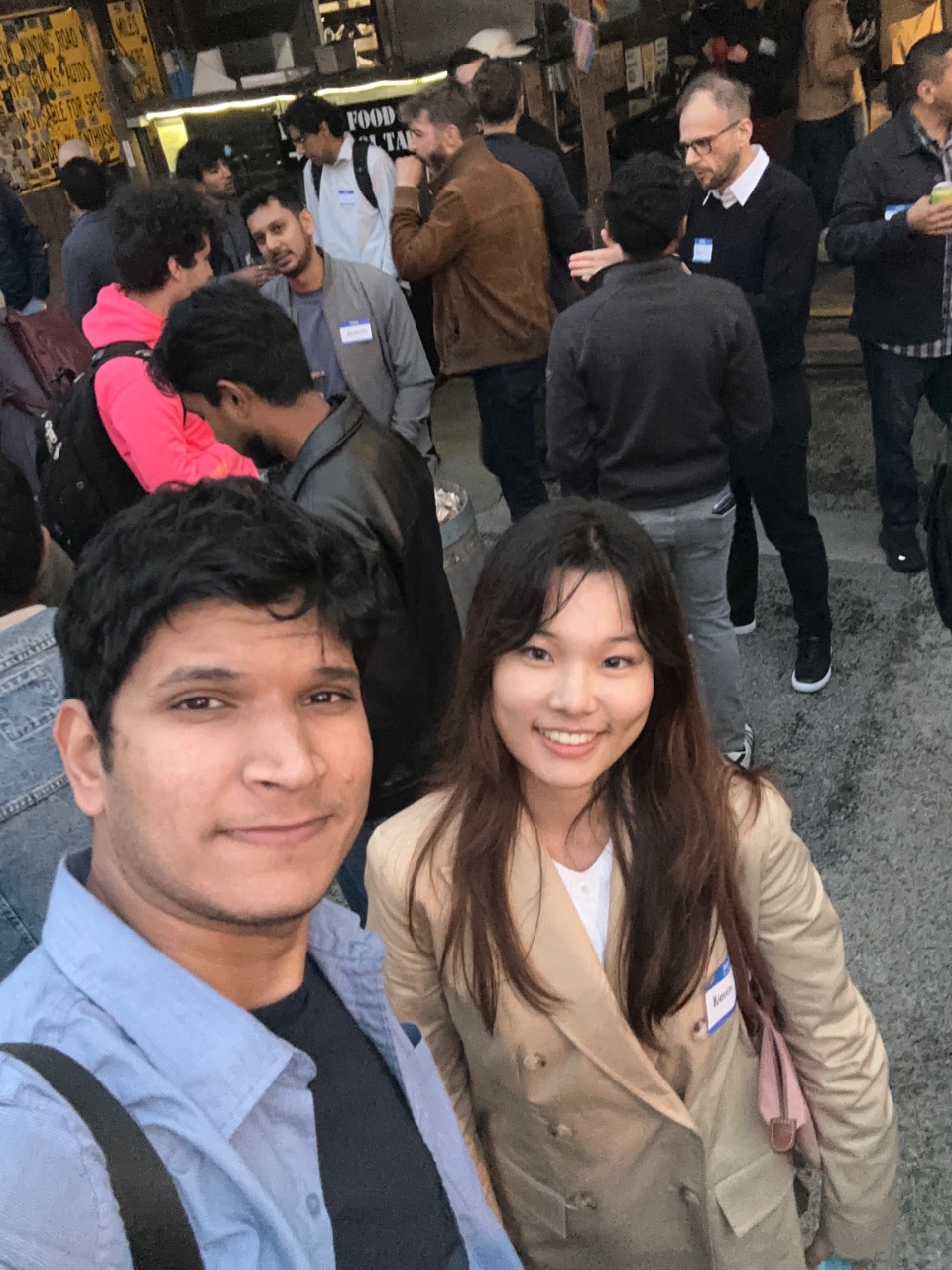
Met Abhi · Sep 23, 2026
HiRey Moments · public interviews
Wenxin Chang on HiRey
Wenxin’s corner of the HiRey Network, from published meetings, Interviews and Connector records. Confirmed in person or interviewedOther public records
## DJI_20260629120859_0031_D
Hello. Hi. Today we met Wenxin Chang. Wenxin Chang. So, Wenxin, tell a little bit about yourself. My name is Wenxin Chang and I just graduated from University of Chicago and I just moved here in San Francisco. And I want to start up a company which is in AI plus education areas and our project is help Gen Z like ADHD or procrastination students to study. We turn boring materials, study materials into very fine drama study learning videos, short videos. So, what do you study in UChicago? Yeah, I study major is AI, Artificial Intelligence Engineering program. Oh, so there is already an AI program? Yeah, yeah. It's highly AI. Okay. I think when I was studying in school there was not a major AI. Okay. It's very up to date. So, what do you teach in the AI program? Many courses, mainly like large language model and some, you know, some related courses. Oh, so you graduated this year? Yeah, I just graduated this year and this program, yeah. So, you entered school in 2022? Oh, it's my master, master, master. Oh, master, master. Yeah, yeah, yeah. Oh, sorry. Yeah, undergraduate is in China and is South China University of Technology at Guangzhou, yeah. Oh, okay. So, two years ago there was an AI focused program. Sounds right. Yeah. I was just thinking, in 2022, how come there is an AI course and the GPT was not even popular? Yeah, yeah, yeah. GPT. But GPT is developing very fast. Yeah. Okay. So, AI. And what drives your interest to the domain you are trying to develop a startup for? Like, what attracts you to the AI education? I think I just made a lot of products, like from March this year and I started as a healthcare project. It's about pets. It's about pets and the family. But I made a lot of products, like in healthcare and in education and also in education decision agents. Yeah, many products. And through the process I found many products can be copied very easily by web coding. So, yeah, so finally I found this really interesting because I want to study web scrolling, you know, not playing web scrolling. So, I want to, yeah, design such a chance to tell students they can also study web scrolling. Well scrolling? Study web scrolling. What's that? Oh, yeah, like you can learn some knowledge through scroll your screen, through short videos or drama videos. That means you can study well playing. So that's really fun. Oh, study well playing. Yeah, yeah, yeah. Okay, gamify the study. Similar, right. Make it a game. Oh, yeah, yeah, like game. And also I want to do some, like, game in education. And I webcoded a game, like chemistry world. It's like an endless map and different chemistry parts are in it. And you can click anyone and then enter the world and to figure out the details. Yeah. Okay, so at the end of the master, maybe in the course you need to develop different projects and you try different things. And finally you found out, maybe something too simple can be webcoded. Maybe something is not your interest and you feel like you need to do something related to study. Yes, yes. Apart from the other things that don't have mode, that's what, that's an investor's mind. From you, from your own personal interest, why you want to do this related to study? Why I want to do this product? I think it's just really fun because I usually, in daily life, I love to watch drama videos or short videos. And it will waste a lot of my time. But I think, why can't I just combine them? And when I make, when I make these AI videos, when I combine the knowledge with the drama, the hooks, all the storytelling, I found this really interesting. Yeah. Okay, so we found out that a human would be more interested with the dramas. And it makes people addicted by nature. Yeah. And you just think about, okay, so still in AI, people need to learn. Why not do it this way? Yeah, yeah. And before they, it was very hard for the education system to produce this kind of content for people to learn. Because I think that's the kind of traditional culture. They think that study is serious. Yeah, yeah. So the short videos or the drama videos, they see the addictiveness of the humanity. Right. So we want to transfer the addictives from playing or the drama or the entertainment into the study. So why can't we, like, be addicted to study? Yeah. Yeah, I think that's the kind of Chinese culture, right? Yeah, Chinese. Why study should be serious? Why cannot it be fun? How fun? As fun as a drama. That's fun as short videos. Yeah, yeah. Okay, I like the idea. Yeah, yeah. That's what I'm trying to say, yeah. Like, at the first place, I want to do some, like, video tutor these days. I want to do AI. Like, AI teacher can teach you all things. And you can naturally ask questions about the AI tutor, about everything. You won't be shy, you won't be fearful to the real teacher. So you just ask everything. That would be a good opportunity for students. Yeah, but I think I want to train a model, like, in the long run. I want to train a model to design AI tutor to help students. Yeah, but, yeah, now I want to do the entertainment part. Okay, so first, about the AI education. The first part is people, or human, is not interested in studying. A lot of them. So you want to make it attractive. Yeah, yeah, that's the point, because the group of students who don't want to study, is more than the students who want to study. Yeah. Yeah, that's the point. Okay, making it fun. And what, um, so how did the project, how did it start? How long have you been working on that? I've been working on this almost three months. Three months? Yeah, I made a lot of videos and posted them on TikTok, and Instagram, and also YouTube. And we have nearly, like, 600 fans on TikTok now. Also, we have a website, and we are transforming to an app, to design an app now. So what's the website? Can you tell us? Yeah, the website, uh, that I need to show you. Uh, you can show me, or you can tell us. Yeah, yeah, yeah. And you have 60,000 organic followers. 600, 600. Yeah, yeah, 600. Turn your course materials into... Yeah, it's our website now. And it shows, like, it can turn every boring study materials into bingeables, uh, study drama, short videos. Yeah, you can create your first drama videos on your own. Like, you can choose different storytelling mode, and choose different characters. And also, you can upload your selfie, uh, so you can be the main character in your own videos. And then upload any study materials, or just one prompt. Then you can generate the videos. Yeah. Mmm. So the, and we also want to do, like, a Dolingo app as our template. Like, you can watch one video or three videos one day, and you keep the daily streak, and join the leaderboard, just like Dolingo. Yeah. So watch drama as long. Let's learn. Okay. Can I see someone? Yeah, yeah, yeah, sure, sure, sure. Oh. Let me show you my TikTok account. It's like nearly 600 fans. And I'll show you one of the dramas. Okay, so I can do it this way. Let's see. I can do it this way. Let's see. Let's see. Or I can do it this way. Let me show you this one. Let's see. So is this a study thing or is it trying to sell that you can learn by... Oh, it's a study thing. You can study the... You can use it at the end. It will show the answer. Yeah, I got it. Okay, I know. I know this is .1. Yeah. You got it. Survivor's bias. Yes, yes. Yeah, that's good. I think it's good. It's good. It's pretty good. Okay, yeah. Yeah, but for now we are still in the process of refining our content, refining the storytelling lines with the knowledge. Yeah. Okay, so you think in the future, airway children, adults, their learning materials will be highly personalized and gamified and a drama. Yeah, because like in your daily study, when you want to study specific knowledge, maybe you can find specific videos to help you study, but now you can just create your own videos to study, just upload your knowledge you want to study. Hmm, I think that's big. We have experience, first, that people have no education, and there is a teacher's voluntary education, but the teachers, they are limited, the workforce, and all the textbook, everything is the same. And now with AI, with the production getting so cheap, and with AI, you can understand it, your audience can make it super personalized, and cheap. So, okay, we can see that future. So, you see the future maybe in five years. Airway children will be addicted to study. Yeah, I hope so, yeah. That's my origin of our product. Okay, cool. So, what's next? What's the bottleneck? The bottleneck, I think, up to now, is like the cost of making AI videos. Now it's cost like 0.05 per second. So, like one video with 40 seconds, it will be like, it will be like, like $2. $2 per 40 seconds videos. So, that's for one concept? Yeah, that's for what concept? $2. Still fine, right? I think that one we have saying, it's not just made for one person. If anyone who's interested in the survivorship bias, you can still serve that $2 outcome to multiple audience. Yeah, I think for my product, I want to design it as if you want to create, like, new videos or personalized videos, I think you must pay for the personalized videos. And for the daily videos, you can watch Shade Black for free. And we will create from the videos you want to study in advance. So, that will not be costly. And then for the creation, you need to pay, yeah. Okay, cost of generation. And secondly, how about the go-to-market? Oh, yeah, I already have like over 20 raw users right now using our website. And they are giving me my feedback, and I iterate my project. And for the go-to-market, that's a really big, big problem, yeah. I'm still in the process. I want to, like, our basic model may be B2B2C. We want to talk with, from some tutorial centers, our schools, our teachers, because our videos can help teachers to, help teachers get their student attention back. Because in class, students may not pay attention to the teachers. They will get bored easily, and they will be distracted very easily. So, I think I can help teachers to make a service for their textbook. Like, before the class beginning, the teacher will show the videos to tell the students what's this class about, and what's the main point. And this is also fine. So, it will get students' attention back. Right. That's excellent for the video you showed me. It's only 40 seconds. Yeah. And it's already very clearly told me what survival shape bias is. Yeah, yeah. It's pretty fast and impressive. And you were talking about ADHD. Yeah. Are you still thinking about that? Yeah, yeah, yeah. I think the first main group of our users would be ADHD and procrastination. Because ADHD and procrastination students, like, they can't pay attention, or they can't just right now start to study. The gap, the gap from playing to study will be very big for them. So, I want to, you know, to help them to turn to study mode very quickly. Hmm. Yeah. That is your pilot users. And for those 20 users, how do you find them? I think mainly from my classmates and my friends. Yeah, and I post, and I make a post at UChicago, and some users just sign up. Okay. And many users, they are from TikTok because our TikTok content is viral. So, one of the students just commented below the videos, and she asked me if I can do AP by all too for her. So, I just made new videos for her, and she signed up for our website. AP? AP by all. It's high school students' content. Oh, okay. Yeah. For her. Yeah. Also, I have some other, another stranger on TikTok, and she talked with me and also signed up for our website. Yeah. And she said it's very convenient for students to just upload and then create. Okay. Yeah, we talk a lot. So, Alex, with those videos you generated, you post them on TikTok, and some of them go viral, and then we can see the true demand. Yeah. And some people reach out to you, want to have their personal. Yeah. Okay. The loop is there, and it's a cost. It's how to go to the bigger market. But still, yeah. Yeah, yeah, yeah. I think you don't need to answer all those questions right now. Yeah. It can develop. Yeah. I think the lags rate can prove that people really love it, because it's over 10% lags rate. And for the students who comment below the videos, it can prove that our videos truly help them study. They want to study more of our videos. I think that's two big signals for our product. Yeah. Okay. That's cool. Um, AI adaptation. What else? What else do you want to talk about? Um, yeah, also B2B2C is our best model. We also want to cooperate with study tutorial center that we can cooperate. Like we can, uh, they can help us bring more students, our users to our project, and we can help them to acquire more students and buy our videos. We can also do some advertisement for them. So it's windy. Yeah. Okay. So you need the resources of those, um, schools, tutor schools. Okay. Got it. Yeah. The end users would be customers, uh, consumers. Yeah. So can we, um, talk more about yourself? Yeah, sure. What else do you want to tell the audience? Uh, I think I have a lot of experience. Like for my undergraduate. Yeah. I, at that time I studied, my major is molecular science and engineering. I studied materials. Uh. Material science? Yeah, material science. Okay. So it must be hard. Yeah, it's really hard. Like I did, uh, the course is just fine for me. Yeah. Uh, but for the lab, I always, you know, stay in the lab and do many research. And I, you know, for the, but the result is good. Uh, I have, uh, patent, a utility patent in China and also published a paper of Jack's AU. Uh, it's a journal in United States. It's very famous. So yeah, that's good for me. Yeah. The time I want to, like, apply for a PhD at that time. Yeah. Yeah. It's, yeah, it's a tough time. Uh, so as an undergraduate published, uh, paper, um, very famous industrial, um. Famous paper. Yeah. Famous journal in, uh, in United States. It's Jack's. Jack's AU. Yeah. Jack's AU. So it's not easy. So it proves you are very smart and hard working. Yeah. I think hard working is the most important one. Yeah. It must be diligent. Like I, usually I every day go to the, uh, lab to watch my experiments because some experiments are really long. You must wait like for one day or two days to watch the results. And then maybe wait for it to cool down and, uh, extract the sample and do some follow, follow processing and then do the characterization. Okay. So what's the paper's name? Paper's name is, it's really long. It's, uh, in the morph, morph areas is, I designed, uh, zinc morph, uh, metal organic frameworks. Maybe you heard of it. It's last year's Nobel prize. Yeah. It's very, but it's very normal materials. It's, it hasn't been already applied into our daily life. It's just in lab. It's just in your search level now. Uh, I'm not from the material background. So what's that? Uh, morph, metal organic frameworks. It's like, uh, organic and inorganic hybrid frameworks. What's that? Oh, that's interesting. Yeah. Uh, the, for the paper, I, I, I made a very, uh, common application. I investigate, uh, morphs in pesticide, like for the daily, daily, daily, daily, daily, like stuff, if there's pesticide left over. Yeah. So we use morphs to test it, to test the percentage of the pesticide left over. Yeah. So what's the name of the paper? I think I can find it out. Oh, it's really long. It's really long. Come on. Tell us what's the name. Ooh. Morph. Morph. Morph. It's called Synergistic Aggregation Induced Immersive Linkers in Metorganic Frameworks for sensitive and consultative visual sensing. And it's JAX? JAX AU, yeah. AU, 2025. Yeah, just last year. Yeah, but it's called a really long time, like nearly over three years, I just published this paper. And you are the second? No, we are the co-first author. Oh, co-first author, okay. Yeah, it's just not show here, but we are co-first author. You can check it in the paper, yeah. Sure, sure, sure. Okay. So you have experienced a very boring study and procedure. Now you want to make it a bump. Yeah, yeah. That makes sense. Cool.
Published, attributed HiRey Moments — never private notes or contact details.
Published by this Person on HiRey.